A perfume bottle is easy to manage at home and surprisingly easy to damage in a suitcase. A loose cap can soak clean clothes, a glass bottle can knock against a charger, and a few hours in a hot car can change the way a fragrance smells. Learning how to pack perfume for travel comes down to four decisions: take only what the trip needs, check the current transport rules, prevent the bottle from moving, and keep it away from heat and direct light. For most U.S. flights, carry-on perfume must be in a container of 100 ml or less and fit with the passenger’s other liquids. Other airports, airlines, and connections may apply different screening procedures, so the route still needs a final check.
Choose the amount and bottle before packing
Take a travel-size amount
A weekend rarely requires several full-size bottles. One daytime fragrance may be enough, while a dinner or celebration can justify a second. A 5 ml to 20 ml travel atomizer is easier to protect than a tall glass bottle and usually covers far more applications than people expect. Use a purpose-made atomizer with a firm closure rather than a loose sample vial. A label is useful for identification, but it should be treated as an organisational aid, not as a universal security requirement.
If the original bottle is small and difficult to replace, decide whether decanting is worth the risk. Some refillable atomizers work well; others leak around the base or overfill easily. Fill and test the container several days before departure. That leaves time to choose another option if the seal is unreliable.
Check the cap, neck, and sprayer
Wipe the bottle completely dry, spray once over a sink, and inspect the neck after a minute. Fresh dampness around the collar or sprayer is a warning. Press the cap gently from different angles. It should not wobble, lift, or activate the nozzle. If the container fails this check, transfer the fragrance to a tested travel spray or leave it at home. A tight suitcase cannot repair a weak seal.
Check airline liquid rules for the whole route
Carry-on perfume
For U.S. airport screening, the current TSA perfume rules allow perfume in carry-on baggage when each container holds no more than 3.4 oz or 100 ml. It must travel with the passenger’s other liquids under the 3-1-1 system. A bottle that is half empty still counts by the capacity printed on the container, not by the liquid left inside.
A compliant travel atomizer is often the simplest choice because it stays within sight and avoids much of the impact associated with baggage handling. Put the liquids pouch near the top of the bag before arriving at security. If the trip includes another country or a transfer through a different airport, check those rules as well; screening equipment and bag procedures are not identical everywhere.
Perfume in checked luggage
A larger bottle may be allowed in checked luggage, but ‘full size’ does not mean unlimited. The current FAA PackSafe limits cap each toiletry container at 500 ml and the combined quantity at 2 L per person. The release device must also be protected against accidental operation. Airlines and destination authorities can add their own conditions.
Checked baggage is dropped, compressed, and exposed to temperature changes. Use it only when the seal is sound and the bottle can be isolated from hard objects. A rare, sentimental, or difficult-to-replace fragrance is usually a poor candidate for the hold even when the rules permit it.
Build two layers of leak and impact protection
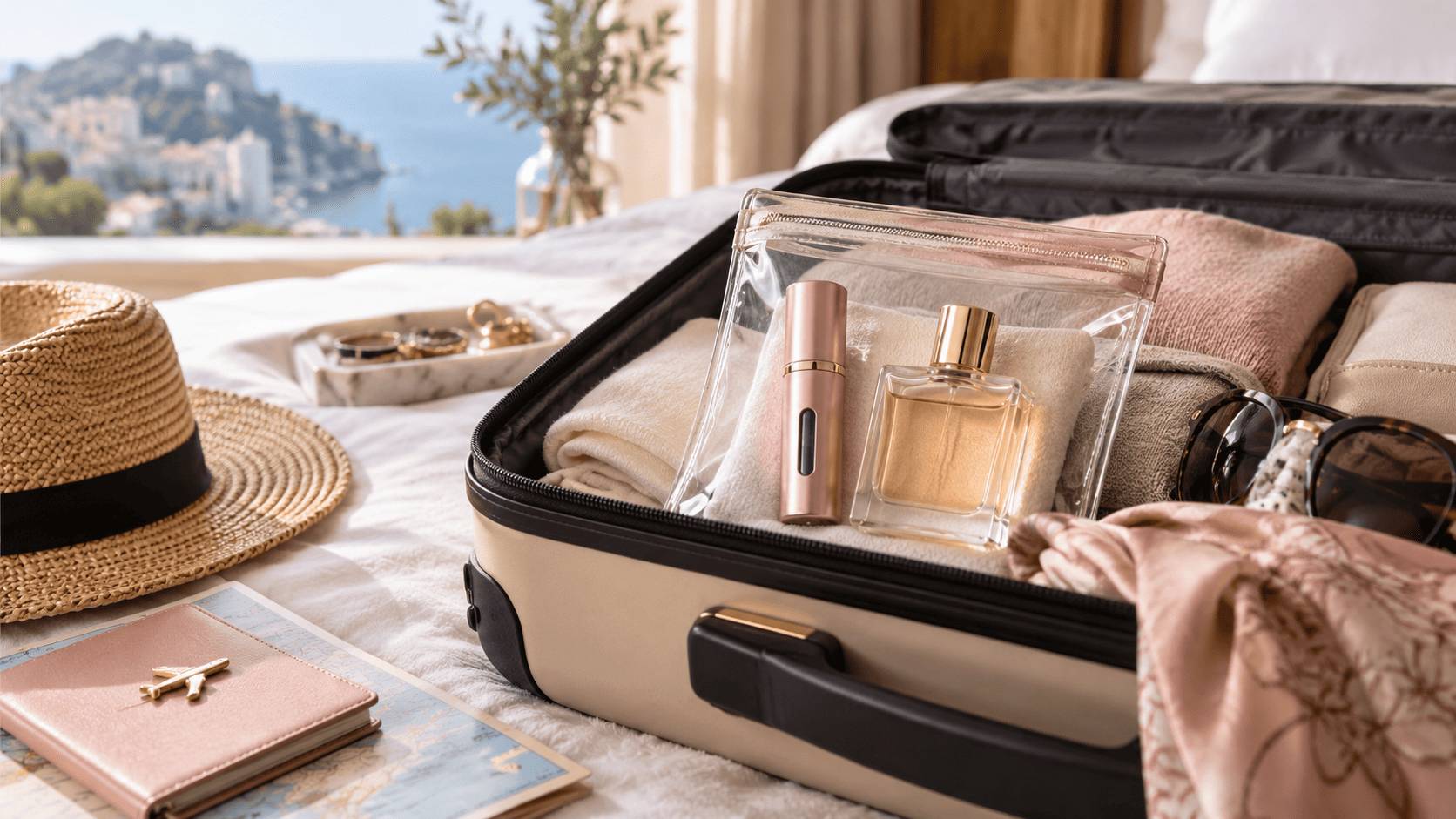
Seal the liquid first
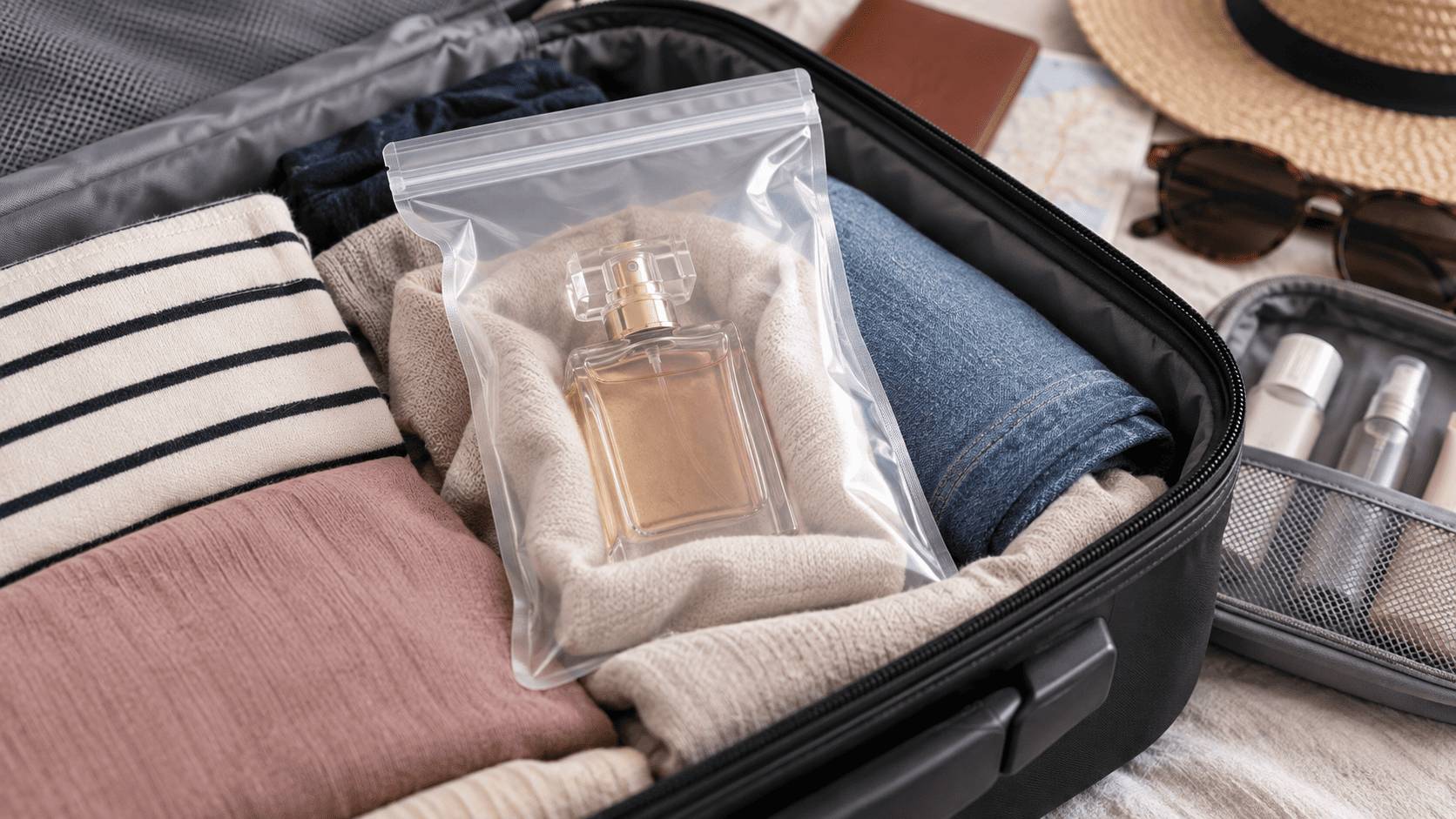
Stand the bottle upright in a resealable pouch and remove excess air without squeezing the sprayer. Glass bottles benefit from a second pouch. The first layer contains a leak; the second keeps dampness away from clothes if the first closure opens. Do not rely on adhesive tape over the cap alone, because tape can loosen and may leave residue without fixing a damaged pump. Keep a spare empty pouch nearby for the return journey, too.
Cushion the bottle from hard objects
Wrap the sealed pouch in a soft shirt, padded wash bag, or fitted case. Place it high in the suitcase and away from shoes, power banks, chargers, books, and laptop corners. With two or three fragrances, pack them separately. One failed sprayer should not be able to damage every bottle or soak the entire travel set.
Road and rail trips avoid airport liquid screening, but the physical risks remain. Keep the bottle upright, shaded, and unable to roll. A pouch placed in a door pocket or loose on a seat can become a projectile during sudden braking, so secure it inside the main bag.
Protect perfume from heat, light, and humidity
A parked car, sunny platform, or beach bag can heat a bottle quickly. Prolonged heat speeds evaporation and can disturb the balance of aromatic materials. Bright light can also change the colour and scent over time. Keep perfume inside the main bag rather than beside a window, and never leave it in a hot vehicle while sightseeing or checking into a hotel.
At the destination, use a cool, dry, dark drawer or cabinet. A bathroom shelf is convenient while getting ready, but it is not a good storage place because showers repeatedly add heat and humidity. After a cold flight or winter transfer, let the bottle reach room temperature before judging an unfamiliar first spray. A temporary change in temperature does not automatically mean the fragrance is ruined.
Inspect the bottle as soon as you arrive
Open the perfume pouch on a clear surface before unpacking the rest of the suitcase. Check the cap, neck, nozzle, and inside of the lining. If anything is damp, move the bottle to a sink, wipe the glass, and place it in a fresh sealed pouch. Do not let a suspected leak touch clothing until the source has been found.
Cloudiness, a marked colour change, or a clearly unfamiliar smell deserves a pause. Let the bottle rest in stable room conditions and test it again later. If the change remains or the cap will not stay closed, stop using the bottle and ask the seller or manufacturer for guidance. Trying to repair a pressurised sprayer in a hotel room can make the leak worse.
Conclusion
The safest way to pack perfume for travel is to reduce the amount, confirm the route rules, test the seal, and use separate layers for leak containment and impact protection. Carry-on is often practical for a small permitted atomizer; checked luggage may suit a larger replaceable bottle only when the applicable quantity limits and protective requirements are met. At the destination, a cool drawer is a better home than a bathroom shelf or sunny windowsill.
Travellers comparing bottle sizes and scent directions can browse the Meiqi perfume range before narrowing the trip to one or two practical choices.
For wholesale or private-label projects that need compact bottles, packaging checks, or travel formats, ask Meiqi about travel-size perfume options.
FAQs
Q1: Can perfume be taken on a plane?
A1: Usually, yes. Under current U.S. screening rules, carry-on containers must hold no more than 100 ml and fit with the passenger’s other liquids. Checked perfume is also permitted within applicable quantity and packaging limits. Always verify the departure airport, airline, connections, and destination.
Q2: How do you pack perfume without leaks?
A2: Test the cap and sprayer over a sink, wipe the bottle dry, stand it upright in a resealable pouch, add a second pouch for glass, and cushion it away from hard objects.
Q3: Is a hotel bathroom suitable for perfume storage?
A3: No, not as a regular storage place. Repeated heat and humidity make a cool, dry, dark drawer or cabinet the safer option.