
A customer can spot a green leaf on a perfume carton from across the shop. What takes longer is deciding whether the claim means anything. Some brands use a lighter box, others talk about natural perfume oils, and a few have changed the whole bottle and refill strategy. These choices are not equivalent. For a buyer building a fragrance range, sustainable perfume is less a single ingredient than a set of decisions that can be checked: where materials come from, how the liquid is made, whether the pack protects the scent, and what remains after use. The questions become sharper when a product is expected to travel through distributors, survive export handling, and be reordered in the same form. A thoughtful sustainable fragrance can still feel polished and long-lasting. It simply needs claims that match the product rather than a decorative label.
Sustainable Perfume Is A System, Not A Marketing Label
A credible claim starts with boundaries. No perfume has zero impact when ingredients, glass, pumps, paper, and transport are involved. The useful distinction is between an improvement that can be described clearly and a vague promise that cannot be checked. Buyers should ask which part of the product has changed and what evidence supports it.
Responsible Materials Need A Clear Story
Fragrance materials may be botanical, synthetic, or a blend of both. “Natural” does not automatically mean lower impact. A delicate flower can require large volumes of plant matter, while a carefully chosen laboratory-made aroma material may relieve pressure on a scarce botanical. Start with traceability: identify the materials carrying the scent character, ask how they are sourced, and retain the supplier record with the approved formula.
Essential oils are often obtained by steam distillation for flowers and herbs; solvent extraction is used for materials that do not tolerate heat well. These choices affect cost, odor profile, and the sourcing discussion. A natural perfume brief should name the desired scent effect and the ingredients that support the claim, rather than promise that every component is natural.
Formula Consistency Still Comes First
An eco-friendly perfume still has to smell right after filling, storage, and delivery. Top notes open first, heart notes define the character, and the base gives depth and persistence. Natural oils, isolates, and selected synthetic materials can all play a role. The buyer needs to know whether the approved sample can be repeated without a change in color, clarity, or drydown when the material batch changes.
For a brief built around herbs, florals, or woods, reviewing a finished reference such as Eastern herbs fragrance helps keep the discussion tied to an actual retail format. The task is not to imitate the scent. It is to decide which notes are central, what substitutions are acceptable, and how the final fragrance will be checked before production.
Packaging Often Carries The Most Visible Improvement
Packaging is where shoppers see an environmental decision, but a weak design can create leakage, breakage, or freight damage. The bottle, cap, collar, pump, label, inner support, and carton must work as one pack. Simplicity matters only if the fragrance remains protected from oxygen, light, and rough handling.
Glass Bottles Work Best When Design Stays Practical
Glass remains the mainstream perfume bottle material and accounts for more than 95% of perfume bottles. It is chemically inert, a strong barrier, and recyclable. Clear soda-lime glass is affordable and easy to form. Colored glass can protect light-sensitive fragrance, while high-white glass gives a more premium look at a higher cost. Flint-style glass may create a crystal effect, but lead or barium content makes it a poor sustainability fit.
Recyclable perfume bottles are not automatically the heaviest on the shelf. Lightweighting can reduce material and freight burden if wall thickness and outer protection still suit the shipping route. Look beyond the glass too: mixed-material caps, metalized plastic, and glued accessories can complicate end-of-life sorting. Fewer well-chosen components are easier to explain and manage.
Cartons And Decoration Need Their Own Review
Sustainable packaging is not only a recycled-carton claim. It can include a right-sized box, reduced void space, suitable paper, water-based paint, PVD decoration where appropriate, and fewer layers. The trade-off is real: a carton that is too light may scuff in transit, while excessive foil, lamination, or complex inserts can make recycling harder. Test the finished configuration instead of approving the bottle and box separately.
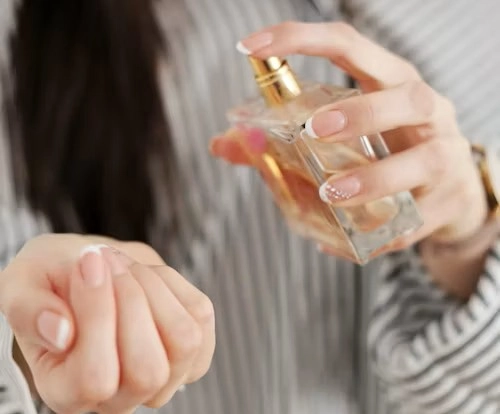
A standard retail format such as the original perfume spray is a useful reminder that a package has to perform in the hand as well as in a sustainability presentation. Confirm cap fit, pump output, label adhesion, carton protection, and transport performance on the actual bottle size before approving the bulk order.
How Buyers Can Test A Sustainable Fragrance Claim
A small set of precise questions is more useful than a long supplier questionnaire filled with generic promises. Start with the claim that will appear on the carton, product page, or sales sheet. Then work backwards through the formula, components, manufacturing route, and supporting documents. If the team cannot explain it in one or two sentences, the claim is unlikely to survive buyer scrutiny.
Ask For Evidence Before Approving Copy
Request the approved formula brief, material declarations for the bottle and major pack components, and the packaging specification. A statement about a bottle that is made of recycled glass has to clearly define what is being referred to. Is it the bottle or the packaging as well? The natural perfume claims need to be internally defined. “Plant-based” does not necessarily mean harmless, vegan, low-carbon, etc. Each of these claims needs to be proven with evidence.
The same discipline applies to fragrance sourcing. A responsible-material story should identify what can be documented, including supplier statements, origin information where available, and any limits created by seasonal crops or proprietary accords. It is better to make a modest, accurate claim than to build launch copy around words the production file cannot support.
Test The Pack With The Liquid Inside
A perfume can be stable in a laboratory bottle and fail in the commercial pack. Alcohol compatibility, odor transfer, evaporation, cap tightness, leakage, atomization, print durability, and carton abrasion all deserve review. Development needs a filled sample, not merely an empty packaging mock-up. Rejected bottles, replacement shipments, and damaged stock quickly erase the benefit of reducing material.
The broader perfume collection gives brand teams room to compare formats before locking a single direction. A 30ml trial item, a 75ml standard bottle, and a 100ml hero SKU can use related visual codes while carrying different protection and material requirements.
Building A Repeatable Program With A Manufacturing Partner
Once the brief is settled, turn the approved sample and pack into a specification that can be reproduced. This is where a brand can lose its original intention. A substitute material, decoration process, or cap supplier may alter recyclability, appearance, or compatibility even when the liquid has not changed.
Keep Formula And Packaging Changes Controlled
A practical control file should record the fragrance sample, fill volume, glass color and weight, pump and cap components, label treatment, carton board, and test results. Any change needs a fresh decision on performance and claim language. Automated filling supports accurate volume and repeatability but does not replace final inspection of sealing, labeling, and finished presentation.
For brands that need help linking the scent brief, bottle development, and production checks, a perfume OEM and ODM service can coordinate formula sampling, proofing, filling, inspection, and mass production. The best time to raise sustainability requirements is before components are selected, while alternatives can still be evaluated without reworking a finished design.
Choose Claims That Can Survive A Reorder
Long-term credibility is based on repeatability. The first launch of a product may be based on a limited stock of special bottles or of special botanical oil. The second production run will then rely on a new supplier, on a different harvest, etc. Therefore, in advance of a first purchase, the buyer and the seller need to agree on a number of alternative solutions and also on when a change of a claim would need to be made. Working with Meiqi has the added value of being able to hand over a responsible concept, translated into concrete, repeatable production. That is far more valuable than a one-off message on a carton that is then thrown away.
Conclusion
Sustainable perfume is credible when its fragrance materials, bottle, pack, testing, and claims tell the same honest story. Buyers do not need a perfect product claim. They need a formula and packaging plan that can be documented, tested, and repeated without hiding the trade-offs. Start with the most meaningful improvements, then keep the evidence with the production file. For help with samples, recyclable bottle options, or a responsible private-label brief, contact 932218963@qq.com.