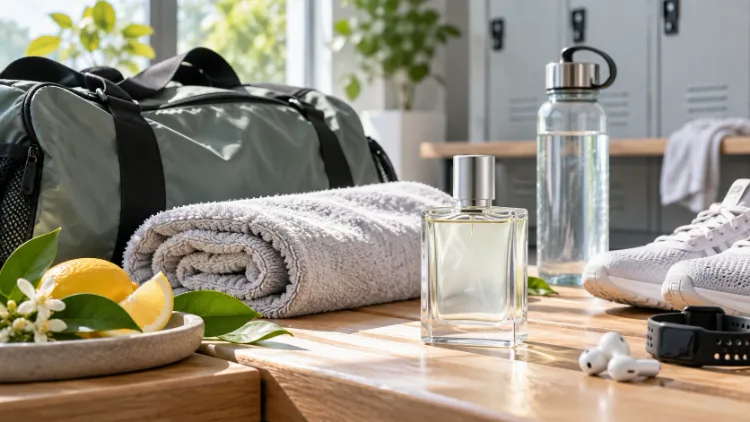
Before wearing perfume for the gym, look around the room. Is fragrance allowed? Is there enough space for people to move away? Heat, motion, close quarters, and deeper breathing can turn an ordinary spray into far too much. When the rules permit scent, reach for a light fresh perfume that has already survived an activity test, then use barely any. Packed class, tiny studio, or scent-free facility? Skip it. Fresh kit, a shower, and suitable deodorant do more useful work than a cloud of perfume ever could.
First Decide Whether Fragrance Belongs in the Room
Start with the room, not the bottle. A broad training floor with steady ventilation is nothing like a spin studio, sauna, changing room, or crowded class. On a busy evening, the next person may be one arm’s length away. Some people are sensitive to fragranced products, which is another reason to respect scent-free rules and keep application minimal in shared spaces. If the gym posts a fragrance rule, the decision is already made.
Even where perfume is permitted, crowded sessions call for restraint. Morning use that has already faded may be enough. A fresh spray before entering a class is much harder for nearby people to avoid. When the choice is uncertain, leave fragrance for after the workout.
This page deals with indoor gym wear, not a general sport fragrance for outdoor activity. A scent that works on a run in open air may behave very differently beside treadmills, mats, and shared lockers.
Heat and Movement Change the Scent
The quickest materials in perfume lift first; slower ones stay behind. Warm skin pushes that process along. During exercise, the heat lasts, the body keeps moving, and fans send the scent beyond the person wearing it. Sweat does not neatly erase the fragrance. On warm skin, sweetness may swell, musk can feel denser, and spice or wood may come forward in a new way.
That is why a wrist test at a shop is not enough for a workout perfume. A fragrance may feel airy while sitting still, then become sweet or sharp after ten minutes of movement. Dense vanilla, heavy amber, smoky oud, leather, and syrupy fruit often need very careful testing in this setting. The issue is not whether those notes are good. It is whether their trail stays comfortable when the body warms up.
Pick Freshness With a Quiet Base
Fresh does not always mean faint. Strong marine accords, piercing citrus, mint, and aromatic herbs can project sharply. Look for a light fresh perfume that feels clear at first and settles into a smooth, close base.
Citrus paired with green tea is worth testing. So are airy flowers, soft herbs, watery notes, pale woods, and clean musk. Tea and green notes can dry out a bright opening; a little musk or wood keeps it from vanishing altogether. Once the citrus fades, the result should still feel easy. Icy, syrupy, or unmistakably perfumed is already too much for this room.
A product such as Signature Blend shows why the full structure matters: its bright bergamot-and-apple opening moves through lavender and cardamom into vetiver, patchouli, and amber. That does not make it a default gym choice; it makes it a useful example to test under movement before judging projection.
EDT or EDP on the box gives only a rough clue. Some eau de toilettes shout, while an eau de parfum may sit close. Formula, skin, and the atomizer all change the outcome. Test that bottle rather than trusting the label. One hard press from a generous sprayer can release much more liquid than a quick tap from another.
Across the fragrance directions developed by MEIQI, similar “fresh” openings can settle into very different bases. For an active setting, the later stage and the scent trail matter more than the label on the front of the bottle.
Run a Real Workout Test Before Wearing It Around Others
Make the first trial somewhere forgiving: at home, or outdoors with plenty of air. Use one small spray, wait twenty or thirty minutes, then start moving. Smell the result after the warm-up. Check again halfway through. The last check comes as the skin cools, because the scent may change yet again.
Judge the air around the body, not the spot under the nose. Does every arm movement throw the perfume outward? Did that soft citrus become sour, or the clean musk turn thick? Warm fabric can release fragrance that seemed to have faded. Repeat the trial in the sort of shirt used for training, not a loose top that never enters the gym bag.
If a fragranced product causes stinging, itching, redness, or other irritation, wash the area and stop using it. Avoid applying perfume directly to irritated, broken, or freshly shaved skin, especially before heat and friction from a workout.
Keep Application Small and Away From Shared Air
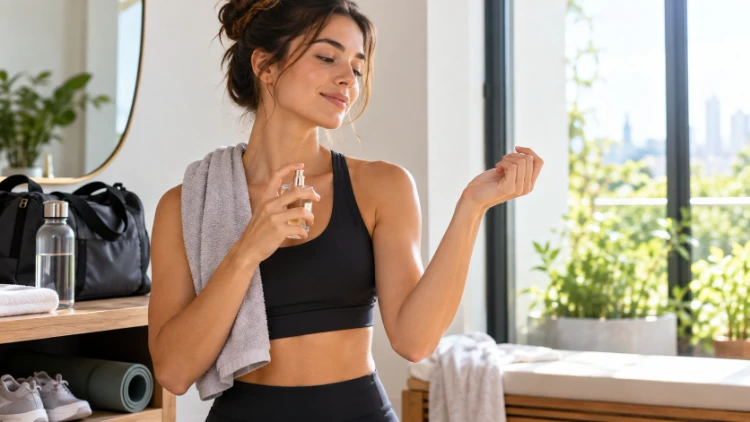
Apply at home, not in the changing room. One light spray under clothing on the torso usually keeps scent closer than spraying the neck, hair, or shoulders. Avoid creating a mist cloud and walking through it. That spreads fragrance over a large area and onto clothes, where it can linger.
No top-ups between sets. After a while, the wearer’s nose stops paying close attention, even though the scent is still reaching everyone else. Another spray drops bright top notes onto hot skin and warm fabric. The result is usually louder, not fresher.
Perfume cannot rescue yesterday’s workout shirt or cover ordinary body odor. Scented wash, deodorant, shampoo, laundry booster, and fragrance may each seem mild on their own. Together they can become a wall of competing smells. Keep most of the routine unscented and the strength of one light gym fragrance is easier to read.
Separate the Workout From the Rest of the Day
Often the best plan is no perfume during training, then a small spray after the shower. That suits a morning session followed by work, lunch, or plans with friends. Carry the atomizer upright in a shaded pocket of the bag. A hot car or sunny window is no place for it. Wait until the skin feels cool and dry before spraying.
The changing room is shared too. Spray sparingly there, or step outside and wait. With the workout finished, a fragrance can have a little more character because constant heat and movement are no longer pushing it outward. The next stop still matters. A bus, clinic, or small office may call for the same light hand as the gym.
Need a few directions to test? Start with the MEIQI perfume collection and compare citrus, tea, airy florals, musk, or pale woods. Put each candidate through a real period of movement before it goes anywhere near a shared workout floor.
If you are developing a lighter scent concept for active or warm settings, develop a more balanced fragrance profile for movement-heavy use with MEIQI before moving from sample testing to a wider project.
FAQs
Q:Should You Wear Perfume to the Gym?
A:Sometimes, but the facility rules come first and the amount needs to be tiny. Leave it off for a scent-free gym, a packed class, or any room where the next person has nowhere else to stand.
Q:How Much Perfume Is Appropriate for a Workout?
A:For a familiar, close-wearing fragrance, one light spray may already be enough. A forceful atomizer or stronger formula may need less, and a crowded or scent-free space calls for none.
Q:Is It Better to Apply Perfume Before or After a Workout?
A:Afterward is easier. Shower, wait for the skin to cool and dry, and use a small amount for wherever the day goes next. Fresh perfume no longer has to compete with heat, sweat, or a crowded training floor.