Pressing a perfume bottle and getting nothing is frustrating, but the missing mist is only the symptom. A button that moves freely, one that will not move, and a nozzle that produces a narrow jet point toward different checks. Repeating the same hard press does little to explain which part has stopped behaving normally.
Before attempting a fix, keep the bottle upright on a stable surface and look at its condition. A cracked neck, loose assembly, or visible leak changes the next step. The useful starting point for a perfume sprayer not working is a clear description of what happens during an ordinary, gentle press.
Start With the Spray Pattern
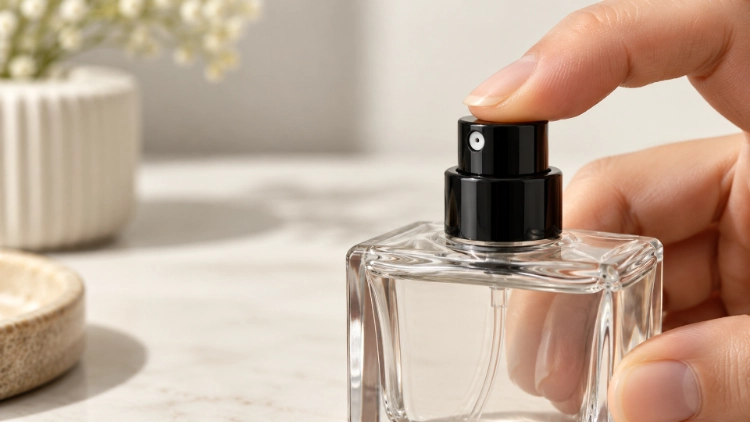
The button, also called the actuator, is the part pressed by the finger. Beneath it, the pump moves liquid toward the outlet; a dip tube typically reaches down into the bottle. A failure anywhere along that path can interrupt the spray. An intact-looking button therefore does not prove that the entire pump works.
| What happens | First observation to make |
| The button moves but nothing emerges | Is the bottle new, nearly empty, or held at an angle? |
| Liquid emerges as a jet | Has the outlet changed from its previous spray pattern? |
| The mist stops and starts | Does the behavior continue when held upright? |
| The button is stuck or the neck leaks | Is there visible damage, misalignment, or seepage? |
These observations narrow the complaint; they do not identify a component failure with certainty. A perfume nozzle not spraying may involve the liquid supply, the actuator, or the pump itself. Work through the behavior that actually appears rather than assuming a blockage.
The Pump Moves, but No Perfume Comes Out
A new pump may need initial priming before liquid reaches the outlet. Follow the bottle instructions and use normal, controlled presses away from the face. There is no universal number of presses for every design. If the mechanism stays dry or feels wrong, continuing with increasing force is unlikely to provide useful information.
Liquid level matters as well. A bottle can contain visible perfume while the tube inlet is temporarily above the liquid when tilted. Return it to the normal upright position and check whether the behavior changes. If perfume remains but cannot be dispensed in ordinary use, report that condition rather than repeatedly shaking the bottle.
An opaque or heavily decorated bottle makes the level harder to assess. The outer glass thickness is not a reliable measure of remaining contents. Describe the use history to the seller instead: newly opened, used normally until yesterday, or nearly finished. Those distinctions help separate a first-use problem from one that developed later.
A Fine Mist Becomes a Jet or Uneven Droplets
A sprayer may still deliver liquid while failing to distribute it as before. Look for residue around the outside of the outlet. If the manufacturer permits it, gently wiping the exterior with a clean, lint-free cloth can remove visible surface material. Avoid pushing fibers, needles, or pins into the tiny opening.
Do not assume that a narrow jet proves the perfume has thickened. Damage to the outlet, an actuator problem, or internal pump behavior can also affect delivery. A short video showing the changed pattern is better evidence than a close-up photo of the bottle alone. Record it against a plain background with the spray directed away from people.
A visibly wet patch around the button is another useful clue. Note whether it appears only during pressing or continues afterward. That observation helps describe where liquid is escaping. It does not justify pulling off an unfamiliar actuator or attaching a spare that merely looks similar.
A Stuck Button or Leaking Neck Needs Different Handling
Check that any removable cap has been taken off and that a specified transport lock has been released. Some packages have locking features; others do not. Turning the button experimentally or forcing it sideways can damage an otherwise serviceable assembly. Use instructions for the actual bottle rather than a video about a different model.
A metal collar fixed around the glass neck is not necessarily a screw closure. Many fragrance bottles use crimped assemblies that are not intended for consumer removal. Pliers, knives, and leverage around the neck can break glass or damage the seal. If the button remains jammed, preserve the bottle and seek a replacement or seller guidance.
Where perfume is leaking, stop pressing and keep it away from heat and ignition sources. Avoid handling cracked glass. A decorative cap is not a repair for a leaking pump or neck seal, and placing the bottle in luggage before the problem is resolved can damage other belongings.
Give the Seller Evidence They Can Use
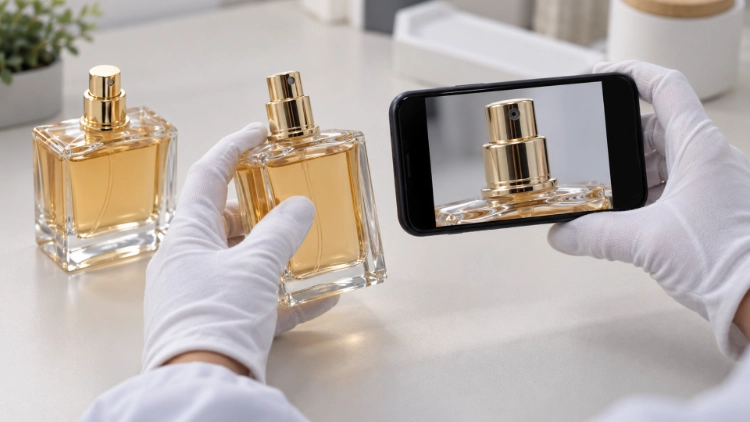
Send the order reference, product version, and a brief account of when the fault began. Add photographs of the outlet and neck, plus a video if this can be made safely. Explain whether the button moves, whether any liquid emerges, and whether there is seepage. Keep the original assembly together until the seller advises what is needed.
The same information helps distinguish among bottles in a mixed order. A description such as “the Signature Blend spray bottle dispenses liquid around the button” identifies both the item and the behavior. It does not assume the fragrance formula caused the fault.
For a New Fragrance Line, Test the Filled Bottle
For brands selecting packaging, MEIQI coordinates bottle selection, cap fitting, filling, labeling, and gift-box assembly. Those connected steps make the filled sample more useful than an empty bottle approved only for appearance. The cap may look correct while the pressing clearance or overall handling still needs review.
When comparing formats within a perfume range, record the bottle and pump combination separately from the fragrance code. Check the first use, repeated actuation, spray distribution, cap fit, and any visible leakage. A favorable scent evaluation cannot substitute for a working dispenser.
Buyers can review bottle and dispensing requirements with MEIQI before approving production details. Include the intended capacity, closure format, decoration, and filled-sample expectations. This is packaging development support; an existing faulty purchase should still be raised with its actual seller.
Conclusion
Match the check to the symptom. A dry first press, altered mist, jammed button, and leaking neck are different complaints. Keep basic observations noninvasive, preserve the assembly, and stop before force or dismantling creates a second problem.
FAQs
Q1: Why does a new perfume bottle not spray immediately?
A1: Some pumps need priming before liquid reaches the outlet. Follow the product instructions and press normally. If nothing changes, or the button is jammed or leaking, contact the seller instead of applying more force. Initial priming does not explain every new-bottle fault.
Q2: Can any spare nozzle replace a broken perfume nozzle?
A2: No. Similar-looking actuators may differ in stem fit, internal geometry, and spray behavior. A loose or poorly matched part can leak or fail to dispense correctly. Ask for a compatible replacement for the actual pump rather than judging compatibility by appearance alone.
Q3: What should happen if a sealed perfume bottle stops spraying?
A3: Record the fault and ask the seller about the appropriate remedy. A sealed or crimped bottle may not be designed for consumer repair. Keep its components and order details together; do not pry off the collar or transfer the contents simply to test a repair idea.