Perfume seems simple once it hits the store shelf. You get a bottle, a cap, plus some scent details on a card. That’s pretty much what shoppers notice. But the true effort kicks in way before that. It begins with picking ingredients, then shifts to pulling out essences and crafting the blend. From there, it moves on to mixing with alcohol, letting it mature, straining out impurities, bottling, capping, and checking quality. Now, in a field where scents are building more business value and customer demands are climbing higher, the top brands aren’t often those with the flashiest tales. Instead, they tend to be the ones with a firmer handle on every stage, right from that initial measure of materials to the very last mist from the nozzle.
What does perfume making really start with?
A good fragrance does not begin at the filling line. It begins much earlier, with a concept that has to become workable in raw materials, evaporation behavior, and wear on skin. That is where perfume manufacturing starts to separate serious work from surface-level imitation.
Raw materials are chosen for both smell and performance
The first step is sourcing. When it comes to making perfumes these days, ingredients tend to fit into three main categories. Think natural extracts first. Next up, those classic ideas drawn from animal sources—folks often switch them now for safer man-made options. And don’t forget the synthetic scent chemicals crafted in labs, which deliver reliable performance, solid staying power, and fresh fragrance twists. Materials like flowers, woods, resins, fruits, musks, and amber-style elements all play a role here. Yet it’s not simply about their pleasant smells. People pick them mainly for how they perform in mixes and once applied to skin. A few evaporate right away. Others linger subtle for about half an hour before they really bloom. Certain ones keep the whole blend stable. Some provide a light boost. And others add real depth.
That’s why choosing raw materials goes beyond a basic “natural versus synthetic” debate. It boils down to real performance needs. Citrus elements can perk up the initial burst in a fragrance. But they often lose steam pretty quick. Rose tends to mellow the overall mix and build in some solid weight. Meanwhile, oud, sandalwood, amber, and musk handle the tougher work down the line. This shows up a lot in Arabic-style setups, where lasting warmth, real depth, and staying power make all the difference. Meiqi’s own perfume knowledge base taps right into this thinking, zeroing in on Middle Eastern profiles that draw heavily from rose, oud, sandalwood, frankincense, saffron, and amber-toned materials.
Extraction and note architecture shape the fragrance before production scales
Once the raw material direction is clear, extraction method matters. Steam distillation is still widely used for flowers and herbs. Solvent extraction works better for delicate botanicals that cannot take high heat. Citrus materials are often pressed. CO2 extraction gives manufacturers another route when they want cleaner capture and better aroma fidelity. These choices affect the final smell more than many buyers realize. The same flower can feel brighter, creamier, greener, or more textured depending on how its aromatic fraction is obtained.
Then comes the real perfume-building stage. The formula has to move as a sequence, not a pile. Top notes usually create the first impression, heart notes define the real identity, and base notes carry the scent after the brightness fades. That structure is not decorative. It is the logic behind why a fragrance feels clean at first, then softer, then deeper. If that transition is clumsy, even expensive materials will feel messy. If it is handled well, the fragrance unfolds with control instead of collapsing after the opening.
How does a fragrance formula turn into a stable wearable perfume?
This is the point where fragrance stops being an idea and starts becoming a product. Many formulas smell promising on paper strips. Far fewer survive the technical work needed to make them stable, clear, wearable, and commercially repeatable.
Dilution, concentration, aging, and filtration do more than people think
After the concentrate is built, it still is not ready. It must be diluted, usually with alcohol and sometimes water, depending on the intended format. Concentration decides a lot: intensity, diffusion, category, and part of the wear experience. Normally, parfum is placed around 20% to 40%, EDP around 15% to 20%, and EDT around 5% to 10%. That matters because concentration changes not only how strong a scent feels, but also how the structure moves over time.
Then the blend is stabilized and aged. This part is easy to overlook if you only think in marketing language, but it is one of the reasons finished perfume smells smoother than a just-mixed trial. During aging, the materials settle into one another. Residual waxy matter can condense out. Cooling and filtration then remove sediment and haze so the final liquid is clear and consistent. In the process notes you uploaded, cooling to below 5°C and careful filtration are treated as key finishing steps, not optional extras.
Desert Bloom and Al Layi show how different formulas follow different manufacturing logic
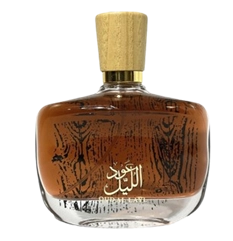
This is where product development gets exciting. Desert Bloom and Al Layi don’t simply offer distinct scents. They push the factory to tackle unique challenges. Desert Bloom comes together as a zero-alcohol fragrance with 28% pure natural essential oils, which include Damask rose, Arabian oud, and jasmine absolute. It draws support from distilled water and natural solubilizers. The scent starts off with bergamot, green mandarin, and frangipani. Then it shifts to Damask rose, jasmine sambac, and a touch of light oud. Finally, it eases into sandalwood, amber, and white musk. Builds like this really fit for folks seeking a gentler, more skin-kind option without alcohol, especially in warmer spots. And that’s exactly how Meiqi sets it up.
Al Layi follows a different route. It uses 15% natural essential oils with agarwood, sandalwood, Damask rose, and jasmine absolute, but it sits in a higher-proof alcohol base with skin-soothing emollients. Its top is bergamot and lemon zest, the heart carries rose, jasmine, and oud, and the base leans into sandalwood, vanilla, and deep agarwood. In other words, it is designed for stronger projection, sharper lift at the top, and a steadier woody trail later on. That is not just a creative choice. It is a manufacturing choice. One formula is solving for alcohol-free elegance and hot-weather comfort. The other is solving for woody diffusion, stronger throw, and a more classic high-concentration Arabic profile.
Both products highlight the way lasting power gets built in, not just hoped for. Take Desert Bloom, for example. It features micro-encapsulation support along with a solid 8–10 hour claim on skin. Al Layi, on the other hand, relies on slow-release technology. That one promises 8–12 hours on skin. Now, depending on how the person wearing it views that—maybe as a real comfort boost or a sense of strength—the core tech stays consistent. It’s all about managing evaporation, holding onto the scent’s form, and ensuring the perfume stays true right from the initial spritz through to the final fade.
What turns a fragrance formula into a product that can actually ship?
This last stage is where many articles get vague, but it is where real factory discipline becomes visible. A perfume can smell excellent in the lab and still fail in the bottle, at the nozzle, during storage, or in transit. Production is not finished when the liquid smells right. It is finished when the whole package performs.
Filling, sealing, and packaging are part of perfume performance
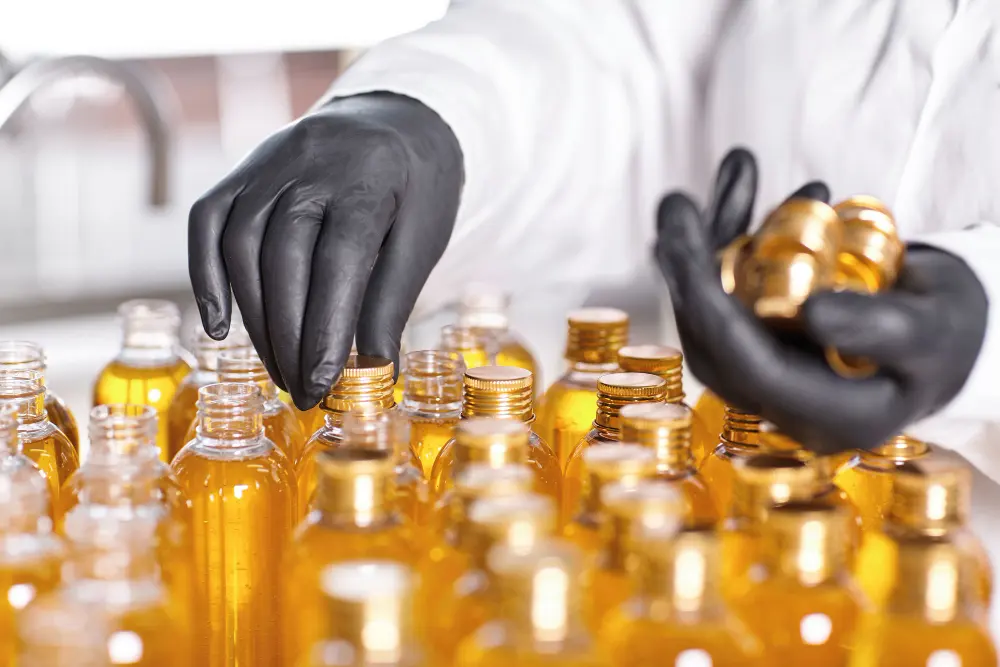
When producing perfume in large volumes, the process hinges on precise measurements, machine-driven blending, and regulated bottling. We achieve this through weighing raw materials right down to the milligram, along with automated stirring and mixing. Plus, our efficient canning lines handle quick yet exact filling. And here’s why that counts so much—fragrances leave no room for slip-ups. Just a slight variation in proportions might shift the aroma, the transparency, or even how well it holds up over time.
The bottle system matters just as much. Glass remains the dominant perfume packaging material, accounting for more than 95%, mainly because it is chemically inert, has strong barrier properties, and gives better long-term protection than lighter packaging options. The nozzle matters too. Seals, valves, springs, spray volume, and atomization quality all affect whether the fragrance feels fine and even, or blunt and messy. A strong perfume in a weak package still underperforms.
Quality control is what protects the fragrance after the formula is finished
Good factories do not treat QC as a last-minute checkpoint. It runs across the chain. Sensory evaluation, chemical analysis, stability testing, durability testing, and batch consistency checks. On the packaging side, there are separate checks for bottle defects, print clarity, seal tightness, spray pattern, pressure leakage, compatibility between perfume and packaging materials, and even drop resistance. Industry-wide, IFRA Standards remain the best-known benchmark for safe fragrance ingredient use, which is one reason serious perfume production has to balance creativity with technical discipline.
That is also why a factory-led perfume article should never stop at “blend oils and pour into a bottle.” Real manufacturing is slower and stricter than that. It is concept, sourcing, extraction, architecture, dilution, maturation, cooling, filtration, filling, sealing, inspection, and only then shipment. When a brand gets those steps right, the final result feels effortless. When it does not, the consumer notices right away, even if they cannot explain why.
FAQs
Q: What is the first step in perfume manufacturing?
A: It starts with concept development and raw material selection. The fragrance direction has to be translated into workable ingredients before blending begins.
Q: Why does perfume need aging before bottling?
A: Because a fresh blend usually smells rougher than a matured one. Aging helps the materials settle together, while cooling and filtration remove haze and sediment.
Q: Is alcohol-free perfume made differently from regular perfume?
A: Yes. The formula system changes. Desert Bloom, for example, uses a zero-alcohol structure with distilled water and natural solubilizers, while Al Layi uses a higher-proof alcohol base to support a different style of diffusion and projection.
Q: What affects how long a perfume lasts?
A:Several things do: concentration, note structure, fixative behavior, release technology, and how stable the formula remains after dilution and maturation.
Q: Why is perfume packaging so important?
A:Because the package protects the formula. Glass quality, nozzle design, sealing performance, and compatibility testing all affect leakage, evaporation, spray feel, and shelf stability.