Learning how to layer perfume is less about collecting bottles and more about controlling the dose. One fragrance should provide the main shape; the second should make a clear, small change. When both scents compete at full strength, the blend becomes hard to read and even harder to wear around other people. A better perfume layering test starts with a familiar anchor, adds one supporting scent, and waits through the dry-down before anything else changes. The aim is not the loudest result. It is a combination that remains comfortable at normal conversation distance and can be repeated without guesswork.
Establish a baseline with one perfume
Choose an anchor that already works on its own. It might be a rose floral, clean musk, dry wood, soft citrus, or warm amber. Apply one light spray and wear it through an ordinary morning. Notice how quickly the opening fades, which notes remain after thirty minutes, and how far the scent travels. If it already feels complete, there is no reason to add another product.
This baseline prevents a common mistake: blaming the pairing when the real problem is dose. It also shows whether a rich perfume becomes sweeter in heat, whether a citrus opening disappears quickly, or whether a musk remains close to the skin. Keep the lotion, clothing, and activity similar when comparing the anchor alone with a layered version.
Build the pair in two controlled stages
Choose one shared note or compatible texture
A shared note is the easiest starting point. Rose and jasmine occupy a related floral space. Sandalwood and clean musk often share a smooth texture. Citrus can brighten dry woods, while restrained vanilla can round off pepper or amber. These are test directions rather than fixed recipes. The strength of each formula matters as much as the note list.
Contrast can work when one side stays quiet. A thin green layer over amber may feel fresh and warm, but several intense notes applied at the same dose often create a muddy result. If the blend is difficult to describe after the first half hour, reduce the supporting perfume before adding anything new.
Use separate wrists before direct stacking
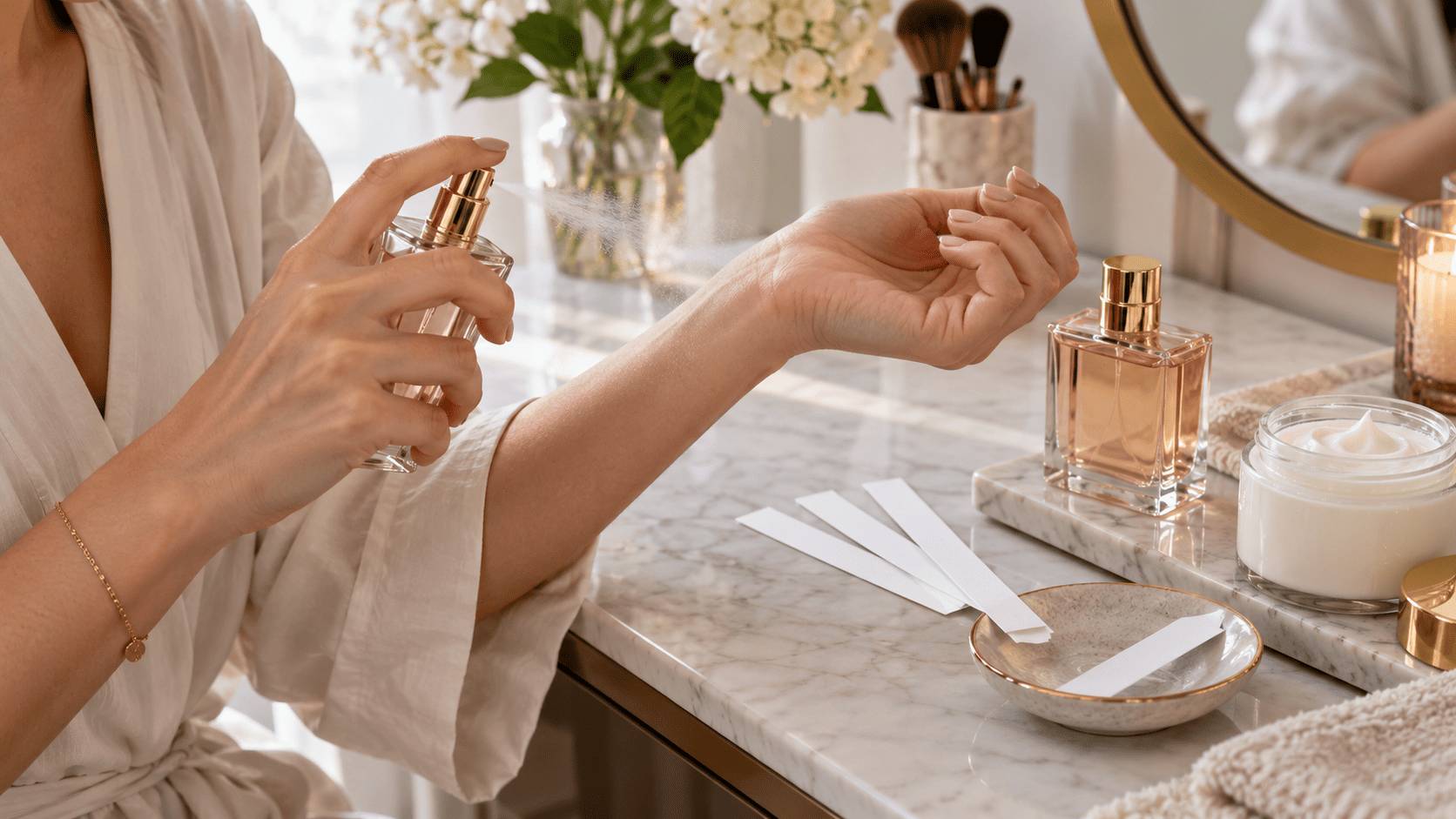
Spray one perfume on each wrist and smell them separately. Then bring the wrists near each other without rubbing. This quick test shows which fragrance expands, which stays close, and whether one disappears under the other. If the pair still makes sense after ten to thirty minutes, test a small amount together on another day.
Starting with the lighter fragrance is a useful beginner method, but it is not a universal law. Spray it first, let it settle, and add a smaller amount of the richer scent. If the richer perfume takes over, reduce its dose or move it to a lower application point next time. Change only one variable per test: order, dose, or location.
Control the total fragrance load
Count lotion, deodorant, and hair products
Fragrance does not begin with the perfume bottle. Scented lotion, shower gel, deodorant, hair mist, and body oil can add sweetness, powder, freshness, or musk before the first spray. Keep the rest of the routine fragrance-free while testing a new pair. An unscented lotion can support a smoother application without introducing another obvious scent direction.
Fragrance is also a common contact-allergy trigger. Anyone with sensitive skin, eczema, or a known fragrance reaction should introduce new products cautiously and stop if redness, itching, heat, or swelling appears. The dermatologist guidance on fragrance reactions explains why a scent family alone cannot predict whether a product will irritate an individual.
Adjust placement instead of adding more sprays
Warm pulse points can increase evaporation and make a fragrance more noticeable; they do not automatically keep it closer to the skin. For a quieter effect, use fewer sprays or place the richer scent lower on the body. Fabric may retain perfume longer than skin, but projection varies by material and formula. Test an inconspicuous area first because some liquids can mark delicate or pale fabrics.
Heat, exercise, crowded transport, and small rooms make a scent easier for other people to notice. Start with one light spray of each perfume rather than treating two full sprays as a fixed rule. A friend at normal conversation distance can give a better assessment than repeatedly smelling the wrist, especially after the nose has adapted to the blend.
Diagnose a blend before replacing it
When a pairing feels too strong, reduce the richer scent first. When it feels sweet and heavy, remove vanilla, amber, or the scented body product from the next test. When one perfume disappears, try it alone to check whether its own projection is naturally soft. A failed test does not always mean the two fragrances clash; the dose, weather, or application point may be wrong.
Write down the names, order, approximate spray amount, weather, and a plain verdict. ‘Citrus first, half spray of musk, still comfortable after lunch’ is enough. A short record makes a successful layered fragrance repeatable and prevents five variables from changing at once. The same discipline used in a perfume longevity test also helps separate opening, dry-down, and projection.
Use blotters when the skin test becomes confusing
Spray each perfume on a separate paper strip, label the strips, and smell them together after ten minutes and again after an hour. Paper cannot replace skin, but it can reveal whether both scents move in a similar direction or whether one carries a dense sweetness that dominates. Use the blotter to narrow the pair, then make the final decision on skin.
Try three simple pairings first
Bright citrus with clean musk is a simple fresh pairing. A soft floral with sandalwood can give the flower a smoother edge. Light vanilla with dry cedar or vetiver can feel warm without becoming dessert-like when the vanilla remains restrained. In each case, keep one perfume clearly in charge.
Use one familiar bottle for half of the experiment. Newness is easier to judge when the anchor already feels comfortable. The Meiqi fragrance collection provides fresh, woody, floral, musk, and warmer profiles that can be sampled separately before any combination is attempted.
Know when a perfume does not need another layer
Many perfumes already move from a clear opening into a textured heart and lasting base. Another fragrance can hide that progression rather than improve it. If the anchor remains balanced at lunch, wear it alone and save the second scent for another day. Rich oud, amber, vanilla, and resinous styles often need less help than their note lists suggest.
Avoid first-time layering before exercise, air travel, a long commute, or an important event. Test on a calm day when the skin can be washed if the result is uncomfortable. A useful blend should be pleasant, repeatable, considerate around other people, and easy to remove. Complexity is not a quality measure.
Conclusion
The simplest way to layer perfume without making it too strong is to establish one scent as the anchor, test the second separately, and change only one variable at a time. Shared notes can make pairing easier, but dose, concentration, weather, body products, and application point often decide whether the blend works. Start lighter than expected and judge the combination after the dry-down, not at the first spray.
Retailers and private-label buyers who want to compare complementary profiles can discuss fragrance samples with Meiqi before planning sets or paired products.
FAQs
Q1: How do you layer two perfumes?
A1: Choose a familiar anchor, test each perfume separately, apply a light amount of the softer scent, pause, and add less of the richer scent. Check the result again after the dry-down.
Q2: Can perfume be layered with body lotion?
A2: Yes. Fragrance-free lotion is the clearest option for testing. A scented lotion counts as another fragrance layer, so reduce the perfume dose and include it in the pairing decision.
Q3: Why does a layered fragrance smell muddy?
A3: The pair may contain several heavy notes, the doses may be too high, or the fragrances may move in different directions after the opening. Reduce one product and retest before changing the whole combination.