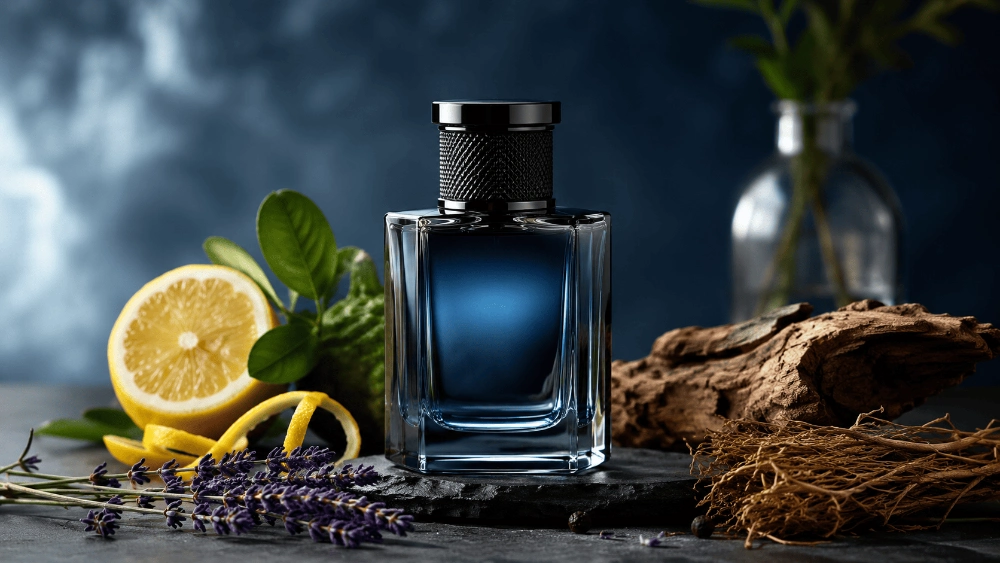
Déposez trois parfums pour hommes sur des buvards séparés et laissez-les reposer pendant une demi-heure. L'un peut commencer par des notes de citron, un autre par de la lavande, et le troisième par une note plus verte. Une fois la première impression estompée, des similitudes apparaissent : une douceur discrète, un cœur aromatique, puis un fond aux accents boisés, musqués, ambrés ou mousseux.
Cette évolution olfactive est plus importante que n'importe quel ingrédient « masculin ». La bergamote peut avoir une senteur fraîche et actuelle dans une composition, et un parfum plus traditionnel dans une autre. Il en va de même pour la lavande, le bois de cèdre, le vétiver et le musc. Leur caractère dépend des proportions, des associations et de la persistance des notes de tête.
Une eau de Cologne masculine classique présente généralement un contraste.
De nombreux parfums masculins classiques commencent par des notes plus légères qu'ils ne s'achèvent.
Les agrumes offrent une première impression de fraîcheur. Des notes herbacées aromatiques peuvent se révéler en arrière-plan, tandis que les notes boisées et musquées se font plus facilement percevoir par la suite. Cette transition d'une fragrance vive à une fragrance sèche contribue à la familiarité du style.
Prenons l'exemple du citron. Associé à la vanille, il apporte douceur et gourmandise. Placez une note d'agrume similaire sur du bois de cèdre ou du vétiver, et l'ambiance change instantanément. Cette impression de sécheresse provient des notes sous-jacentes à l'agrume.
La lavande est tout aussi versatile. Associée au santal et à un musc doux, elle offre une fragrance suave. Mêlée au vétiver, à la mousse ou à un accord boisé plus affirmé, elle prend une sonorité beaucoup plus traditionnelle.
L'ouverture est censée bouger
Une erreur fréquente lorsqu'on juge un parfum est de s'attendre à ce que la première impression olfactive persiste pendant des heures.
Non, et ce n'est pas souhaitable.
La bergamote, le citron, l'orange et le pamplemousse sont des notes de tête courantes car elles sont perceptibles et relativement volatiles. Elles apportent de l'énergie à l'ouverture ; par la suite, les notes plus lourdes se révèlent plus facilement à mesure que les notes vives s'estompent.
Le romarin, la menthe ou la lavande peuvent accompagner les agrumes et rendre l'ouverture plus verte.
La transition vers le cœur est cruciale. Si une attaque vive et hespéridée laisse place brutalement à un cœur riche et sucré, le changement peut paraître abrupt. Une touche herbacée, boisée ou sèche en tête peut rendre la transition plus naturelle sur la peau.
C’est au milieu que le style se révèle pleinement.
Une fois que la première bouffée d'agrumes s'estompe, le parfum est plus facile à apprécier.
La lavande est souvent présente car elle relie les notes de tête fraîches aux notes de fond boisées. Le romarin peut lui donner une touche plus verte, le géranium une note florale, et des épices discrètes réchauffent le cœur.
C’est là que deux eaux de Cologne similaires peuvent rapidement diverger. L’une devient herbacée. L’autre prend une note légèrement poudrée. La troisième acquiert une chaleur avant que les notes boisées ne se manifestent.
La liste des ingrédients ne le précise pas. « Bergamote, lavande, bois de cèdre » peut décrire un parfum sec et vif ou plus doux. Les proportions et les autres ingrédients influencent le résultat.
Quels changements altèrent réellement les essences de bois lors du séchage ?
« Boisé » est un terme générique. Le cèdre, le santal, le vétiver et le patchouli appartiennent à la même famille, mais ils ne produisent pas le même fini.
Le bois de cèdre peut donner une sensation de sécheresse et de fermeté. Le bois de santal est plus doux et rond. Le vétiver apporte souvent une sécheresse terreuse, évoquant les racines. Le patchouli peut approfondir le fond. Le musc agit généralement discrètement en arrière-plan, tandis que l'ambre ajoute de la chaleur.
Un parfum boisé aromatique peut conserver une sensation de fraîcheur car le bois ne se révèle pleinement qu'après la disparition des notes d'agrumes et d'herbes. La bergamote associée au cèdre offre une impression de vivacité. Les agrumes et le vétiver ont tendance à évoquer une fragrance plus terreuse. La lavande, sur fond de santal et de musc, apporte une touche de douceur.
Voir Meiqi collection de parfums pour hommes pour des parfums plus masculins.
Fougère Still Explains a Lot
Le mot fougère Cela peut paraître technique, mais l'odeur elle-même est familière à beaucoup de personnes qui ont porté des parfums masculins classiques.
Les structures traditionnelles des fougères sont généralement associées à la lavande, au géranium, à la coumarine, à la mousse de chêne et à des matières aromatiques ou boisées. Il est plus facile de se représenter la forme que de mémoriser la liste : des notes fraîches ou herbacées en tête, des notes plus sèches et plus profondes en dessous.
Certaines fougères anciennes peuvent paraître denses aujourd'hui, car leurs notes poudrées, mousseuses ou sucrées sont mises en avant. Les interprétations plus récentes conservent souvent la base aromatique tout en allégeant le reste.
Une formule pourrait utiliser moins de mousse, un musc plus pur, des agrumes plus vifs ou des bois plus légers. Le parfum appartient toujours à la même famille olfactive, mais sa texture change.
Cette distinction est utile lors du développement d'un produit. « Masculin moderne » est vague. « Bergamote éclatante, lavande herbacée, vétiver sec, faible douceur » offre au parfumeur des éléments concrets à tester.
Pourquoi certaines eaux de Cologne classiques semblent-elles démodées ?
Le problème ne vient généralement pas de la lavande, de la mousse, du bois de cèdre ou d'un autre ingrédient prétendument ancien. Le plus souvent, c'est un composant de la formule qui a été utilisé en excès.
Un cœur poudré peut dominer. Un fond mousseux peut devenir dense. Un ambre profond peut rendre le sillage plus chaud que prévu. La douceur peut atténuer le contraste entre la fraîcheur de l'ouverture et le fond.
Souvent, un léger ajustement suffit. Une touche de bergamote peut rehausser une ouverture dominée par la lavande. Le vétiver peut adoucir un fond sucré et lui donner une finale plus sèche. Le musc peut adoucir un accord boisé trop âpre, tandis que le santal peut assouplir une composition qui paraît trop rigide avec le seul cèdre.
Ces changements ne suppriment pas la structure classique. Ils modifient simplement son aspect, le rendant plus ou moins traditionnel ou contemporain.
EDC, EDT et EDP ne sont pas des étiquettes de style.
La concentration modifie la tenue d'un parfum, mais elle ne détermine pas si celui-ci est classique, moderne, masculin ou boisé.
À titre indicatif, l'eau de Cologne a une concentration de parfum d'environ 3 à 5 %, l'eau de toilette d'environ 5 à 10 % et l'eau de parfum d'environ 15 à 20 %. Ces fourchettes permettent d'évaluer l'intensité et la tenue du parfum, et non sa qualité.
Une eau de toilette légère peut tout à fait posséder une base boisée convaincante. Une eau de parfum plus riche peut accentuer les notes de cœur et de fond, mais une concentration excessive peut aussi rendre une formule dense plus lourde.
La direction du parfum est primordiale. La concentration est une décision qui viendra plus tard.
Comment transformer le « masculin classique » en un briefing utile
En matière de développement de produits, « eau de Cologne masculine classique » est une expression de départ, et non un cahier des charges définitif.
L'ouverture doit-elle privilégier la bergamote et le citron, ou les herbes ? Le cœur doit-il être dominé par la lavande, plus vert, ou légèrement épicé ? Le fond doit-il être sec et boisé, chaud et musqué, ou plus sombre ? Quelle quantité de douceur doit persister après la disparition des notes de tête ?
Ces questions sont plus utiles lors de l'échantillonnage.
Une version fraîche pourrait associer bergamote, lavande et vétiver. Une version plus douce évoluerait des agrumes vers le santal et le musc. Une version plus profonde conserverait une ouverture aromatique tout en intégrant des notes ambrées ou de oud en fond.
Les marques peuvent consulter les avis sur Meiqi. fabrication de parfums et solutions de parfumerie lors de la réduction d'un concept à un échantillon.
Une fois la direction définie, les étapes suivantes sont pratiques : échantillons, choix des bouteilles, conditionnement, remplissage et production. Chez Meiqi Services de parfumerie OEM et ODM Nous proposons différents modèles de produits. L'OEM convient généralement aux acheteurs ayant des exigences plus précises en matière de parfum, de formule, de marque ou d'emballage. L'ODM est plus adapté lorsqu'un projet débute avec une formule, un flacon ou une structure de produit déjà existants et les adapte pour une marque privée.
Conclusion
L'idée d'une eau de Cologne classique pour homme offre une grande variété de possibilités. Une formule peut s'articuler autour des agrumes et du vétiver ; une autre peut mettre en avant la lavande et les notes boisées. Les deux peuvent procurer une sensation familière si le parfum évolue naturellement de ses notes de tête jusqu'à son sillage.
Pour le développement d'un parfum, cette approche est plus pertinente que de rechercher systématiquement le terme « classique ». Un acheteur peut être précis : une ouverture plus lumineuse, moins poudrée, des notes boisées plus douces, une douceur moindre ou un sillage plus chaleureux. Ces détails permettent de transformer une idée générale en un échantillon exploitable.
FAQ
Q1 : Une eau de Cologne pour homme a-t-elle besoin de lavande pour avoir une odeur classique ?
A1 : Non. La lavande est courante, notamment dans les parfums de type fougère, mais ce n’est qu’une option. Les agrumes associés au vétiver, au bois de cèdre ou au musc peuvent créer une ambiance tout aussi familière sans que la lavande soit la note dominante.
Q2 : Pourquoi une eau de Cologne classique peut-elle avoir une odeur différente après 20 ou 30 minutes ?
A2 : Les notes que l’on perçoit en premier ne sont pas toujours celles qui persistent le plus longtemps. Les agrumes peuvent dominer en tête, puis s’estomper au profit de la lavande, des notes boisées, du musc ou du vétiver. Se fier uniquement à la première vaporisation peut être trompeur.
Q3 : Comment une marque doit-elle décrire un parfum masculin classique à un fournisseur ?
A3 : Privilégiez des choix précis plutôt qu’une description vague. Une brève description comme « notes de tête de bergamote, notes de cœur herbacées, notes de fond de vétiver sec, faible douceur » est bien plus précise pour un fournisseur qu’une simple demande pour une eau de Cologne masculine classique.